Make a choice
Express a preference in a way other people can understand: a look, gesture, picture, sound or words.

Self-sufficient life · the purpose from the start
Choosing what to wear. Asking for help. Taking part in a family meal. You want these moments to become more possible for your child. At Pinnacle, that life gives the work its direction.
Pinnacle / BHCL · Free 24/7 telephone guidance. The team confirms appointments, suitable professionals, services and fees.
How Pinnacle connects the work with life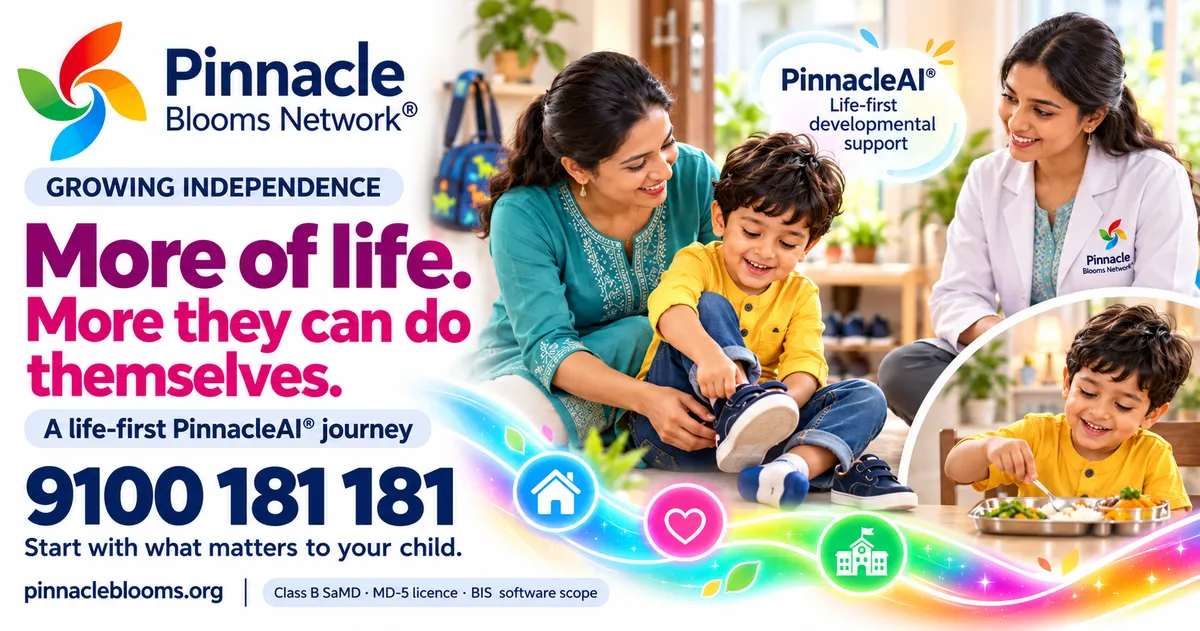
Start with the life you want to open up
Growing self-sufficiency means taking a greater part in everyday life with the support that fits your child. It includes making choices, communicating needs, managing routines and knowing when to ask for help. A useful plan starts with the life you want to make possible, then chooses the relevant goals, people, methods and review.
Express a preference in a way other people can understand: a look, gesture, picture, sound or words.
Take part in getting dressed, eating, organising belongings or another moment that matters at home.
Communicate when help is needed and remain involved in the activity. Independence can include support.
Discuss a meaningful next step in learning, play or the community, with the right people and surroundings.
The PinnacleAI® paradigm shift
You build a home for the life it makes possible. Its individual bricks serve that purpose. At Pinnacle, meaningful communication, routines, learning and participation give assessment, therapy, practice and review their direction.
Your family helps choose the priorities, understands the plan and brings real-life observations into review. Suitable professionals choose and adjust relevant support around your child.
Read the documented life-first approachOne example · a useful way to think about the process
“My child wants to come outside with us. How can they take more of a part in getting ready?”

In this example, a child enjoys going outside, points to their blue shoes and can press a fastening closed when an adult holds the shoe. The family chooses a useful next step with the child: take more of a part in putting on shoes for an outing they want to join. Asking for help remains part of the goal.
A suitable professional and the family look at communication, movement, shoe fit, comfort and the place where the routine happens. For this example, they agree to try a stable seat, an opened fastening and a familiar help gesture. These are choices to review for this child, rather than instructions that every family must follow.
The family offers a manageable opportunity at home when the child chooses to get ready. With consent and the teacher’s agreement, the same familiar cues can be available on a nursery bench. An illustrative observation: at home the child puts a foot into the shoe and closes the fastening with help; during a busy nursery transition, they ask the adult to do it. The amount of help and the surroundings both matter.
In this illustrative review, the family, relevant professional and consenting teacher agree to keep the help gesture and opened fastening, and make a seated opportunity available before the busy transition. They agree when to review the child’s chosen participation, comfort and remaining help in both settings. The child can pause or decline. Useful support stays available; independence is not measured by removing every form of help.
This is an illustrative planning example, not a recorded child outcome. Your child’s choices, your family and suitable professionals shape the actual goal, adaptations and review.
Seven stages · one life-first direction
Start with strengths, everyday observations and suitable assessment. Read AbilityScore with the child’s age, context and skills.
Explore this part →Discuss what you want to make possible and agree useful priorities. Readiness views support professional judgement.
Explore this part →Bring in the therapies, educational support or health review that fit this child. Every child does not need every service.
Explore this part →Use manageable, guided practice in meaningful routines. Family participation connects the work with daily life.
Explore this part →Bring relevant observations back into review. Ask what became useful, what support remains and what needs to change.
Explore this part →Compare abilities and context over time. Continue, adapt or complete support according to the child’s needs.
Explore this part →Keep self-sufficiency, learning, relationships and mainstream participation in view. Progress is individual.
Explore this part →Family knowledge + suitable professional support
Look at the meaningful activity, the choice they made and their comfort.
Notice useful prompts, people, tools and surroundings. Needing support does not erase participation.
Bring observations into professional review. Goals and methods can change as abilities and circumstances change.
Speech therapy can support communication. Occupational therapy can support daily activities and participation. Behavioural support and special education can contribute when the child-specific priorities indicate them.
Confidence with a source you can inspect
The child’s self-sufficient, mainstream-included life sets the direction for abilities, goals, methods, people, everyday practice and review. This is the programme purpose; outcomes are individual.
Read the source →The scope schedule names Self Sufficiency and Mainstream Inclusion within the software system. A named module is distinct from a demonstrated child outcome or school admission.
Read the source →PinnacleAI GPT-OS v1.0.0 is Class B non-diagnostic developmental-support software for children aged 0–12. The licence describes the device’s scope, not a guaranteed result.
Read the source →Inspect each study’s question, version and publication status. Methodology, research protocols and completed findings have different meanings.
Read the source →Pinnacle Blooms Network is the brand operated by Bharath Healthcare Laboratories Private Limited.
Read the source →Questions families ask
It means growing participation in everyday choices and routines with appropriate support. Communication, self-care, learning and asking for help can all contribute. The meaning and goals are individual to the child.
No. Useful support, adaptations and asking for help can be part of independence. The family and professional discuss which activities matter, what the child can do and what support helps.
Start with one everyday moment you want to make more possible. Discuss present abilities, a suitable assessment, meaningful priorities, the people and support involved, family practice and how progress would be reviewed.
No. Assessment and the child-specific priorities guide the relevant professional contributions. Speech, occupational, behavioural or educational support may play different roles; a fixed bundle is not assumed.
No. PinnacleAI GPT-OS is licensed non-diagnostic developmental-support software. MD-5 and BIS describe their printed scopes. They do not guarantee a child’s independence, school admission or outcome.
Call 9100 181 181 to describe one meaningful everyday priority, or send a short enquiry. The receiving team confirms the appropriate professional, centre, appointment, service and fees before a visit.
Bring one moment that matters
The first conversation can help clarify a suitable assessment, professional and centre. You can ask what the visit includes, how your family participates and how the work will be reviewed before deciding.