Choose English to return to the original. Other languages use Google Translate. Original documents remain the reference.
PINNACLEAI® · THE WAY FORWARD
Your child’s life is the mission. PinnacleAI® puts it first.
The purpose is a child’s everyday life.
Because every child deserves a wonderful life.
Communicating. Learning. Making choices. Taking part. Pinnacle’s purpose is a self-sufficient, mainstream life for your child. That purpose guides the abilities, goals, techniques and support brought into the work.
Communicating a need. Making a choice. Learning with others. Growing independence. These are reasons to choose the work—not questions to leave until the sessions are over.
PinnacleAI® starts with that purpose, understands the child’s abilities and helps select the goals, methods and people to serve it.
An engine, wheels and a steering system matter because of what they enable together: a car that takes you where you want to go. A collection of parts leaves the bigger job with you.
PinnacleAI® asks what each goal contributes to your child’s life before choosing the technique. Every specialist’s contribution has a purpose.
A word matters when it helps a child ask, choose or refuse. Holding a pencil matters through participation in learning. The purpose reaches beyond completing the task.
PinnacleAI® links the child’s priorities with observable goals and practice. The supplied communication example shows how a life ability can shape a session.
An ability matters through what it makes possible.
Understand the abilities. Set meaningful goals. Choose the methods and people. Practise where life happens. Review what the child can use, and adapt the work.
A self-sufficient, mainstream life for your child is Pinnacle’s purpose. PinnacleAI® brings that purpose to each decision, with people guiding the work and the child’s needs shaping the next step.
Children need abilities they can use to communicate, learn, participate and grow in independence. Pinnacle challenges an approach that starts with a technique, then leaves families to discover how separate gains add up to the life they want for their child.
01
A task improves. The life question remains.
A child may perform an exercise more successfully while the family still needs to understand what it enables in learning, communication, choice or participation.
02
The family is left to join the parts.
When recommendations are fragmented, parents must work out how separate assessments, specialists and sessions serve the same child’s life.
03
Progress needs a place in real life.
A review needs to ask where an ability is useful, which support the child needs and what to work on next—not only which tasks were completed.
WHO & UNICEF · 2023
WHO and UNICEF’s 2023 report documents unmet needs, fragmented systems, waiting lists and exclusion. It calls for people-centred services and support for caregivers.
The 160-year framing is Pinnacle’s historical argument. These are care problems and decision models, not a finding that every provider failed. WHO–UNICEF documents care gaps; it does not endorse PinnacleAI® or establish its comparative superiority.
The PinnacleAI® philosophy
Your child’s life decides the work.
Self-sufficiency and mainstream participation give the work its direction. At Pinnacle, the life purpose comes first; abilities, goals, methods, specialists, everyday practice and review follow from it.
1
Name what matters in life
Understand the child and family’s priorities for communication, choice, learning, participation and growing independence.
2
Understand the abilities
Use AbilityScore® and the child’s everyday observations to understand the starting point and the support needed.
3
Give each goal a purpose
Make the intended ability observable, so the family can understand what the goal would mean in the child’s life.
4
Choose the people and practice
Select the methods, specialist contributions and everyday programme around those goals, with human guidance.
5
Bring learning into daily life
Parents, caregivers, educators and therapists contribute through the child-specific programme and feedback.
6
Review. Learn. Adapt.
The Personal Development Kernel brings the child’s information and feedback into review. Ask what is becoming useful and let that guide the next decision.
The measure of the work is what it helps make possible in the child’s life.
Self-sufficiency and participation are the purpose of support. Each child’s progress, support needs and outcomes are individual.
See the philosophy inside the work
“Help.” “More.” “Stop.”
Follow a life ability into the supplied goal and session example. Explore the complete story and its evidence at your pace.
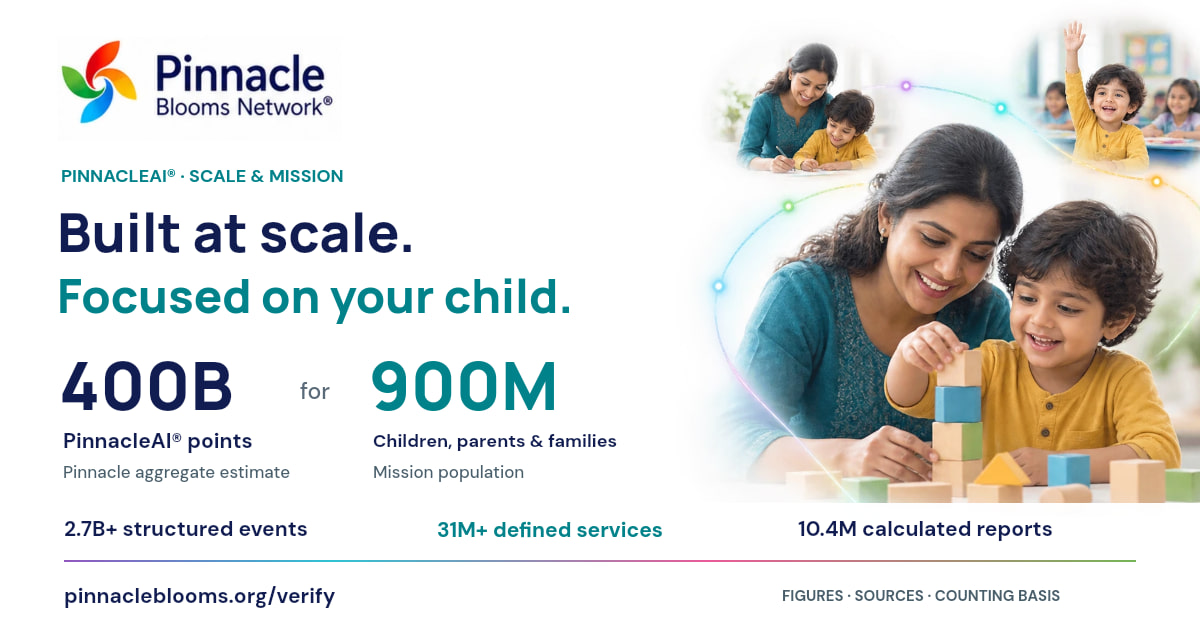
Behind every number is the same purpose: helping a family understand their child’s abilities and plan what comes next. Explore the scale of the system—and the source behind each figure.
400 billion is Pinnacle’s aggregate estimate; its full calculation has not been independently reproduced here. 900 million is the mission population, not people already served.
Pinnacle's owner confirmed this as a current calculated total on 19 September 2026. The component counts supplied do not reproduce 400 billion. A point definition, reproducible calculation, deduplication rules and measurement cutoff have not been supplied. This aggregate is not established by the linked UDIN reports.
Built for 900 million children, parents and families is the mission described in the 7 September 2026 handout, pages 1, 7 and 20. It is not a count of people served or an independently established estimate of unmet need.
2.7B+ · Clinical AI data points
2.7B+ structured developmental events at 17 July 2026 in SRS 4400 annexure p3, item 5. SAE 3000 separately covers a 2.5B+ floor. Clinical AI data points is Pinnacle’s description; the report counts structured events, not necessarily independent clinical observations or AI-training examples.
31M+ · Therapy & developmental services
31,052,382 cumulative services at 17 July 2026 in SRS 4400 annexure p3, item 1. The defined total includes assessments, screenings and parent training. SAE 3000 separately provides limited assurance over the 31M+ floor. This is a volume measure, not a successful-outcome count.
10.4M · Calculated report outputs
1.3 million completed assessments × eight reports = 10.4 million report outputs. Pinnacle’s owner confirmed on 19 September 2026 that each assessment produces one cumulative AbilityScore and seven readiness-index reports. This is arithmetic based on that operational statement; a complete report-generation log has not been inspected, and the linked practitioner reports do not establish this report total.
1.3L+ · Intervention techniques
130,000+ techniques, owner-supplied operational update, 19 September 2026. A dated inventory extract has not been inspected. The earlier September handout describes 90,000+. The linked UDIN reports do not verify this updated figure or the separate clinical effectiveness of every technique.
792,614 unique beneficiary/family registrations at 17 July 2026: SRS 4400 annexure p3, item 2. SAE 3000 separately covers the 790,000+ floor. This is the defined registration measure, not an independently verified outcome count.
Pinnacle describes everyday programmes with nine personalised intervention techniques, nine therapeutic goals per service in its programme model, and family/therapist feedback feeding review and correction. These are programme descriptions; no deduplicated totals for programmes, goal assignments or Fusion Module entries were supplied. The 31M+ cumulative service definition also includes assessments, screenings and parent training, so it cannot automatically be multiplied by nine to establish unique therapeutic goals.
These categories describe different, potentially overlapping units. They must not be added or multiplied to imply unique children, independent observations or a verified aggregate. Programme, goal and feedback-entry totals are not quantified here.
Independent practitioner evidence: SAE 3000 limited assurance and SRS 4400 factual findings, with separately defined scopes. Both UDINs were verified Active on 19 September 2026.
A practical comparison question, not a claim that no other provider worldwide has comparable capabilities. No exhaustive global comparison has been established.
Your child expressing a need. Joining a classroom. Taking part in family life. PinnacleAI® connects measurement, people, daily practice and review around the abilities that matter to your child.
The seven-stage care pathway Pinnacle Paradigm Shift: one connected plan.
One child. One connected plan.
A shared direction toward self-sufficiency, mainstream participation and a wonderful life.
The parts matter. So does how they work together.
When you picture a car, you picture where it can take you. The engine, steering and wheels each have a job—and need to work together. A child’s support plan needs that connection too: clear goals, coordinated care, practice beyond the session and a way to check what changes.
FROM A STARTING POINT TO EVERYDAY PARTICIPATION
Seven stages. A plan that keeps learning.
01
Understand abilities
Start with what your child can do today.
How it connects
AbilityScore® brings observations into a structured starting point for discussion with the care team.
Pinnacle uses the term for a connected approach to child development: begin with everyday-life goals, measure abilities, agree a personal plan, connect professional support and home practice, then track, correct and reassess. The phrase describes its approach; it is not a claim of worldwide exclusivity.
How are parents included in the licensed intended use?
The MD-5 annexure names parents, therapists, educators and caregivers as intended users of non-diagnostic developmental-support software for children aged 0–12. It describes ability measurement, readiness tracking, progress forecasting and adaptive therapy-plan support. Family participation works alongside appropriate professional guidance.
What connects the approach to self-sufficiency and mainstream life?
The BIS scope names developmental mapping, planning, everyday therapy, tracking and correction, seven readiness indexes, Self Sufficiency and Mainstream Inclusion across the full developmental lifecycle. These named functions describe the direction and scope of the system; individual outcomes depend on the child and their care context.
At 17 July 2026, the SRS 4400 report records 2.7 billion+ structured developmental events, 31,052,382 defined cumulative services and 792,614 beneficiary/family registrations. A separate SAE 3000 report provides limited assurance over specified institutional assertions. The claim map links each figure to its source page; these volume measures are distinct from child outcomes.
Explore the documented process through an illustrative family scenario. This guide uses no child data and does not perform an assessment.
01
Observe
Start with everyday life.
A family wants to help their child express a choice during a familiar routine. They describe what the child already does, what interests them and where support helps.
The family and professionals review the starting point and agree a useful goal. Pinnacle describes the Personal Development Kernel as the child-specific record connecting measurements, context and responses.
People + a connected record
The care team checks the goal and the support appropriate to this child.
The overall AbilityScore® report and seven readiness views help organise the discussion. The important connection is from the report to an agreed everyday goal.
One profile. Seven readiness views.
Explore what each report is for below. No individual child’s results are displayed here.
The documented Everyday Therapy™ programme links selected techniques with goals. In this illustration, the care team explains a communication activity within a familiar routine and agrees how the family can take part.
Guidance for the people around the child
The activity, support and practice schedule are agreed with the care team.
Feedback connects the experience at home with the next review. Try either response to see how the discussion can change.
The care team reviews what happened, discusses the activity and support with the family, and agrees what to try next.
For a difficult activity, discuss a smaller step or more support. For an activity the child can manage, discuss a suitable next challenge. These are examples of a review conversation.
An illustrative feedback example
This demonstration does not assess a child, prescribe an activity or generate a treatment plan.
The care team reviews feedback, adjusts goals or support, and discusses the next assessment. Monthly reassessment is described in the reviewed methodology and walkthrough.
Keep the child’s everyday life in view
Look for meaningful changes in communication, routines, learning and participation, alongside the scores.
Each index report includes an “Assessment By” field. Read the results with the assessment context and care-team explanation. Readiness-index titles are not diagnoses; the Study/IQ Readiness title should not be read as an independently established IQ test. Report presentation version V-1.6.9.9 is separate from the SaMD software version.
Perhaps you want your child to ask for what they need, take part in a family routine or feel more confident with others. The journey begins by understanding their current abilities, then agreeing what to work toward with the care team.
HOW PINNACLEAI® WORKS
Your observations shape the next plan.
PinnacleAI® connects measurement, a child-specific plan, guided everyday practice and feedback. The purpose is practical: help the child build abilities that matter at home, in school and in everyday life.
01 · Understand
AbilityScore®
Bring observations into a structured view of the child’s present abilities and readiness.
02 · Plan
Personal Development Kernel + Prognose®
Connect this child’s history, goals and responses to the next recommendations.
03 · Practise
TherapeuticAI® + Everyday Therapy™
Turn goals into guided activities that the care team and family can put into practice.
04 · Review & adapt
Fusion Module + reassessment
Bring people’s feedback into review, adjust the plan and reassess progress over time.
One child’s history connects each cycle. What the family and professionals observe today informs what they review next.
Explore the part that matters to you
What do the child’s reports explain?
One overall profile. Seven focused readiness reports.
The eight supplied report examples present an overall AbilityScore® and seven readiness indices on a 0–1000 display scale. Together, the overall profile and focused views give the family and care team a shared starting point for discussing priorities and the next plan.
Speech Readiness IndexA focused view to discuss communication priorities.
Behavior Readiness IndexA focused view to discuss behaviour and participation.
Motor Readiness IndexA focused view to discuss movement-related abilities.
Study/IQ Readiness IndexThe report’s named view of readiness for learning.
School Readiness IndexA focused view to discuss preparation and support for school.
Self-Sufficiency IndexA focused view to discuss growing everyday independence.
Mainstream Readiness IndexA focused view to discuss participation with other people.
Each index report includes an “Assessment By” field. Read the results with the assessment context and care-team explanation. Readiness-index titles are not diagnoses; the Study/IQ Readiness title should not be read as an independently established IQ test.
Report titles checked against eight supplied examples on 19 September 2026. The overall report cover identifies report presentation version V-1.6.9.9. This is a review of report format, not an independent study of outcomes.
This public guide describes the report structure. Children’s identities, individual results and original reports remain private.
Parents and caregivers contribute observations from everyday life; therapists and educators bring the context they see. The MD-5 intended use explicitly names parents, therapists, educators and caregivers. Their participation connects home routines with professional support.
The reviewed dossier describes the clinical AbilityScore® as clinician-administered and clinically governed. A family questionnaire should therefore be distinguished from the clinical assessment and score.
It is the child-specific developmental record described in Pinnacle’s architecture: measurements, goals, responses to activities, environment and history stay connected. That record informs subsequent recommendations, so the next plan can take earlier experience into account.
For a family, the useful question is simple: how did what we observed last time change what we will do next?
The documented programme connects selected activities to the child’s goals and abilities. The September handout describes 7–9 daily techniques and a four-day therapy forecast. The methodology preprint describes programmes delivered four days ahead, giving families time to prepare.
The care team should explain the selected activities, demonstration and support appropriate to the child. Programme counts in different publications vary; the agreed individual plan determines what to practise.
What happens when an activity is too hard or does not engage the child?
That experience is useful feedback. The methodology preprint describes 1–9-star technique ratings feeding the Personal Development Kernel. The BIS schedule names parent, family, caregiver, therapist and clinical tracking and correction through the Fusion Module. This makes review of the plan part of the described workflow. The dossier describes human oversight of recommendations; technique selection is not left to the system alone.
Illustrative example: the family records difficulty with an agreed communication activity; the care team reviews the observation, adjusts the activity or support, and reviews the response at the next check. This explains the feedback loop; it is not a patient case or a promised result.
Compare the child’s present abilities with earlier assessments, discuss progress and difficulties, and agree the next priorities. The company walkthrough and methodology preprint describe monthly reassessment. A useful review connects the score with observable changes in the child’s daily life.
The BIS scope names seven readiness indexes: School Readiness, Speech Readiness, Motor Readiness, Study IQ Readiness, Behavior Readiness, Self Sufficiency Index and Mainstream Inclusion Index. These names describe the modules; they do not promise school entry or independence.
The company describes parental-consent controls and role-based access for the clinical and caregiving people involved in the child’s programme. Access should support coordinated care while respecting the child and family’s privacy.
The dossier documents the access model. Families can ask their care team which people have access and how permissions and consent are managed for their child.
This explains the workflow described in the cited documents. The MD-5 establishes the intended use of a non-diagnostic Class B device for ages 0–12; the BIS schedule names the software and quality-system scope. Research methods, workflow descriptions and evidence of clinical outcomes are different types of evidence.
Document versions and measurement detail
The supplied September report examples display AbilityScore® and all seven readiness indices on a 0–1000 scale; the overall cover identifies report presentation version V-1.6.9.9, separate from the SaMD software version. The older methodology preprint describes readiness indices on a 0–100 scale. These are version-specific descriptions and should not be combined without a crosswalk. The preprint also describes 400+ Personal Development Kernel data points, while the company walkthrough describes 4,000+ developmental data points; those counts need a current version-specific definition.
A broad view of development, organised into abilities and skills that can inform a child-specific plan. The direction is practical: what helps this child communicate, learn, manage daily routines and take part in life?
17
Developmental domains
The broad areas considered in Pinnacle’s framework.
79
Abilities
The capabilities the framework helps organise.
349
Skills
More detailed skills to connect with individual goals.
591 observations · AbilityScore® 0–1000
The company-described observation framework and score support a starting point and subsequent progress review. A child’s plan selects relevant priorities; the totals do not mean every child needs every intervention.
Pinnacle-defined architecture: company walkthrough, page 26; September handout, pages 5–6. The standards below supply classification and terminology; WHO does not define these numerical totals. An item-level domain–ability–skill crosswalk has not been independently audited in this review.
Different starting points. Meaningful everyday goals.
Families may arrive with questions about autism, ADHD, communication, sensory processing, movement, learning or other developmental concerns. Pinnacle’s stated purpose centres on the capabilities that help each child grow toward self-sufficiency and participate in mainstream life, with the support and accommodations they need.
Communication and choice
Express a need, make a choice and connect with other people.
Daily-life independence
Build participation in familiar routines and practise useful daily-living skills.
Learning and belonging
Take part in school, relationships and community with appropriate support.
These are examples of individual goals, not promised results. Professional assessment identifies the support appropriate to each child; diagnosis and medical care remain important where indicated. The licensed software’s scope is non-diagnostic developmental support for ages 0–12, not treatment of every condition.
What happens in a therapy session needs to connect with life at home and school. Assessment, therapy, everyday practice and review are most useful to a family when the people involved understand the same goals.
Pinnacle describes a shared pathway that brings those steps together around your child. Diagnostic information still matters for clinical care and access to support. Alongside it, the plan keeps communication, daily routines, learning, relationships and participation in view.
Connect professional support, home practice and participation.Explore all seven stages and their sources
AbilityScore® · 0–1000
01 Understand the child’s abilities
Begin with what the child can do, their interests and the everyday situations where support would help. Pinnacle describes 17 developmental domains, 79 abilities and 349 skills, supported by 591 observations and an AbilityScore on a 0–1000 scale. These are different layers of its developmental framework.
For the family: A starting point the family and care team can discuss together.
Connect the observed abilities with priorities, readiness goals and a plan for this child. The dossier describes a personal development kernel: a persistent child-specific record of measurements, responses to techniques, environment and history that informs subsequent recommendations.
For the family: Clarity about what to work on next, why it matters and who will help.
Use the plan to coordinate appropriate therapies and intervention. Pinnacle describes practitioners, parents, caregivers and educators contributing to the programme; software supports professional judgement and shared goals.
For the family: People working from an agreed direction across the child’s support team.
The September handout describes 7–9 techniques selected for the child’s programme each day. Parents and other caregivers receive guidance for practice connected to the child’s current abilities and goals; the care team agrees what is appropriate.
For the family: A practical way to carry support into home routines and other everyday settings.
Record how practice goes and bring observations from the family and professionals back into review. The BIS schedule names parent, family, caregiver, therapist and clinical tracking and correction through the Fusion Module.
For the family: A plan that can respond when an activity, setting or support needs to change.
Compare the child’s present abilities with their own earlier assessments and review the next priorities. The company walkthrough describes a monthly AbilityScore refresh; the Whitebook also describes monthly review. The care team should explain the schedule and any child-specific changes.
For the family: An understandable record of change over time, connected to daily-life goals—not a judgement of the child’s worth.
Work toward communication, daily living, learning, relationships and participation in school and community. The BIS scope names seven readiness indexes, including Self Sufficiency and Mainstream Inclusion. Continue reassessment and support as needs change.
For the family: A wonderful life defined with the child and family, including the supports that make participation possible.
Review → adapt → practise → reassess. Progress review feeds the next plan. The direction is growing capability and participation, with continuing human support.
This is Pinnacle’s documented developmental-support approach. PinnacleAI® GPT-OS v1.0.0 is a non-diagnostic Class B SaMD for ages 0–12 under the supplied MD-5. A programme, score or licence does not guarantee independence, school entry or a particular outcome. Inclusion is a right; it is not conditional on a score.
Measurement versions and review cadence
The company walkthrough labels 17 domains, 79 abilities, 349 skills and 591 observations as different layers. The September 2026 handout also describes 349 skills, 17 domains and 591 observations. The earlier Whitebook uses 344 skills across six domains. The dossier acknowledges architecture changes, but a complete crosswalk between versions was not supplied. Newer counts should not be attached retrospectively to validation of an older version.
A 0–1000 score is a company-described developmental measure. It is not a diagnosis, an IQ score, a credit score or a guarantee of future independence. Review the methods and limitations alongside the number.
For a family, evidence becomes useful when it helps answer three questions: What can my child do now? What will we work on together? How will we understand what changes?
A starting point you can understand.
Begin with what your child can do today. Use the assessment to discuss the abilities you want to build next.
Understand who does what: your care team, your family and the people supporting your child each day. Pinnacle’s pathway is designed to connect that work.
Communicating a need. Joining a family routine. Taking turns. Participating at school. These are examples of goals to discuss—not promised results. The plan should reflect your child’s abilities, preferences and support needs.
Ask how your child’s starting abilities, goals and progress will be measured, when the plan will be reviewed and how practice carries into home and school.
Before you choose a care team, take a closer look at who stands behind it. Follow Pinnacle’s licences, original records and centre details to the documents themselves.
TOPIC 04Pinnacle at a glanceThe organisation, its identity and its documented approach.
PINNACLE AT A GLANCE
Measurement. A connected plan. Support for everyday life.
Pinnacle Blooms Network is a brand of Bharath Healthcare Laboratories Private Limited. Pinnacle describes a seven-stage child-development pathway connecting ability measurement, child-specific planning, integrated support, parent-guided practice and progress review toward participation and growing independence.
The documented combination brings together non-diagnostic Class B developmental-support software, a BIS scope schedule naming connected software modules, and a centre network with individually traceable source records. These documents explain the approach and its scope; each child’s plan and outcomes remain individual.
An issued licence defines the software’s intended use. Quality records describe how the system is managed. The BIS schedule connects those processes to a broader set of developmental-support modules.
APPLICATION HISTORY
MD-3
The application for a manufacturing licence. It is part of the regulatory record, rather than a second approval.
The schedule names software development, deployment and maintenance, plus ability mapping, parent-guided practice, progress correction and readiness modules.
Parents are explicitly included in the licensed intended use.
“The software is intended to assist parents, therapists, educators, and caregivers by providing developmental ability measurement, readiness tracking, progress forecasting, and adaptive therapy-plan support for children aged 0–12 years.”
MD-5 MFG/MD/2026/000248 · intended-use annexure · 21 April 2026
Bring guided developmental practice into everyday life. The licensed intended use names parents and caregivers alongside therapists and educators. Families have an explicit role in using the software’s developmental-support functions, with goals and guidance appropriate to their child.
Pinnacle’s Everyday Therapy programme and Fusion Module describe how that participation connects with daily practice, feedback and professional review. The BIS schedule names parent, family and caregiver tracking and correction as part of the connected developmental journey.
The intended use identifies whom the software assists and what it supports. It does not confer professional therapist credentials, register a home as a therapy centre or replace appropriate clinical care. A worldwide exclusivity claim is not established by these documents.
“for the full developmental lifecycle of children.”
The schedule names AbilityScore, Prognose®, the Everyday Therapy Programme through TherapeuticAI®, the Fusion tracking and correction module, and seven readiness indexes—including Self Sufficiency and Mainstream Inclusion.
This is the named quality-system and software-module scope. The MD-5 records the device’s four intended functions: ability measurement, readiness tracking, progress forecasting and adaptive therapy-plan support. Both documents retain their named software and premises. The MD-5 intended population is ages 0–12; individual outcomes remain subject to the child’s circumstances and support.
Read the full software and developmental-module scope
“Design, development, verification and validation, release, deployment, maintenance, technical support and post-market surveillance of Software as a Medical Device (SaMD), including Pinnacle AI GPT-OS™, and Developmental Support Software (Non-Diagnostic), including developmental ability mapping (Ability Score), prognostic engine Prognose®, Clinical Intervention Every Day Therapy Programme through Therapeutic AI®, Parent, Family, Caregiver, Therapist, Clinical Tracking and Correction Fusion Module, School Readiness, Speech Readiness, Motor Readiness, Study IQ Readiness, Behavior Readiness, Self Sufficiency Index, Mainstream Inclusion Index, 7 readiness indexing and associated digital developmental support modules for the full developmental lifecycle of children.”
BIS MD/L-2026029599 · schedule page 2 · line breaks normalised
Parents, therapists, educators and caregivers are the intended users. The licensed software supports developmental work; it does not diagnose, approve every therapy centre or guarantee a child’s outcome.
Class B is a risk classification under India’s rules. US FDA Class II is a different jurisdiction’s classification; neither is a universal ranking of quality or clinical superiority. CDSCO · Medical Devices Rules
What this supports: The supplied Form MD-5 licenses the listed Class B device for manufacture for sale or distribution at the specified premises. Intended users include parents, therapists, educators and caregivers supporting children aged 0–12.
Scope: Applies to the named device, version, intended use and premises. It does not establish diagnostic authority, clinical effectiveness or the registration of every centre.
Medical device regulationOriginal reviewedExport-purpose certificate
FSC · Free Sale Certificate for export
Export-purpose certificate issued on the MD-5 licence · PinnacleAI® GPT-OS v1.0.0
What this supports: The supplied certificate records that Bharath Healthcare Laboratories Private Limited holds manufacturing licence MFG/MD/2026/000248 under Form MD-5 and is permitted to manufacture the listed device for sale in the domestic market under Indian law and for export as per the law of the importing country. The device particulars agree with the operative MD-5 scope: non-diagnostic developmental-support software, Class B, version 1.0.0, for parents, therapists, educators and caregivers supporting children aged 0–12.
Scope: A Free Sale Certificate records the Indian regulatory standing and export eligibility of the named licensed device. It is not a registration, approval or marketing authorisation in another country; each importing regulator applies its own requirements. No validity period is printed on the certificate. It does not establish diagnostic authority, clinical effectiveness, comparative superiority or the registration of any centre.
Source inspected: 24 September 2026 · Original certificate and forwarding letter inspected. Their populated signature fields were observed, but cryptographic signature validity was not independently verified.
IS 23485:2019 · Licence and scope schedule reviewed
What this supports: The supplied BIS licence and schedule cover the specified software design, development, verification, validation, release, deployment, maintenance, support and post-market surveillance. The schedule names developmental mapping, planning, everyday practice, tracking and correction, with school, speech, motor, Study IQ, behaviour, self-sufficiency and mainstream-inclusion readiness modules across the developmental lifecycle.
Scope: The licence applies to its schedule and listed address. It is not a guarantee of clinical outcomes for a child.
What this supports: The official GLEIF record matches the company name and CIN. It reports entity status ACTIVE and LEI registration status ISSUED.
Scope: A legal entity match establishes identity within this registry. It does not establish clinical outcomes, device permissions or current tax compliance.
Medical device regulationOriginal reviewedApplication + issued licence
CDSCO classification · Application and licence trail
Original application reviewed · Class B is recorded in the issued MD-5
What this supports: The issued MD-5 identifies the device as Class B. Company publications describe a preceding Central Licensing Authority classification decision.
Scope: The locally available risk-classification form is an application proposing Class A, not the approved Class B decision. A classification decision is also distinct from a manufacturing licence.
Medical device quality-management system · ISO 13485:2016
What this supports: The supplied certificate covers the named company’s quality-management scope for the design, development, deployment, maintenance and support of the specified SaMD.
Scope: Certification applies to the certificate’s system scope. Historic “diagnostic mapping” wording does not extend the later MD-5’s non-diagnostic intended use. Accreditation-chain and live certificate status have not been independently checked.
Information-security management system · ISO/IEC 27001:2022
What this supports: The original certificate covers information-security management for the listed SaMD platforms, cloud operations, cybersecurity, data protection and support.
Scope: Certification does not guarantee zero breaches or cover every process outside the declared scope. Current certificate status and the accreditation chain remain separate checks.
The legal entity behind the supplied core credentials
What this supports: The certificate records the change from Bharath Diagnostics Labs Private Limited to Bharath Healthcare Laboratories Private Limited. The CIN agrees with the live GLEIF record.
Scope: A historic incorporation/name-change certificate establishes the recorded identity event. Current MCA filings, directors and compliance require current MCA records.
DIPP8651 · Issued recognition with an updated-certificate check due
What this supports: The supplied recognition certificate and an official historical Startup India list identify the company as a recognised startup.
Scope: Recognition is distinct from a tax-exemption certificate, healthcare approval or an award. Current eligibility and status should be read from the updated certificate and applicable rules.
UDYAM-TS-20-0015132 · Business-registration record
What this supports: The later supplied Udyam record identifies the company and records a Small enterprise classification for FY 2025–26.
Scope: This is enterprise registration, not an MSME award or a clinical accreditation. Enterprise classification can change; the displayed snapshot is not a live September 2026 confirmation.
Original 2017 REG-06 reviewed · Historical registration with the printed legal and trade names
What this supports: The 2017 GST certificate records registration under the names printed on that document. The MCA name-change certificate supplies part of the corporate-name history.
Scope: The original retains the former legal name. A current GST taxpayer record or amended certificate is needed before describing the current name and registration status as matched. GST registration does not establish clinical quality.
Corporate PAN card inspected · Identifier withheld from display
What this supports: The supplied corporate PAN card identifies the company and its incorporation date.
Scope: PAN supports tax identity. It does not establish current tax compliance or clinical authorisation. Live PAN verification has its own matching-information and OTP requirements.
What this supports: The authenticated dashboard matched all 53 earlier inventory IDs and supplied three additional complete IDs, giving 56. Each record retains its displayed workflow status and observation date. The source workbook and certificate references remain available beside the live check.
Scope: Exact HFR identifier matches and dashboard workflow statuses are separate from current centre operations, clinical quality, outcomes and other location-specific permissions. Approved applies only to the displayed NHPR workflow state; Query Raised, Submitted, Rejected and Query Resolved retain their literal meanings. One masked Draft is excluded from complete-ID totals. No replacement or cancellation relationship is inferred between additional IDs. The observation covers one authenticated NHPR account; registrations administered in other accounts have not been reconciled here.
Source inspected: 19 September 2026 · All 56 complete identifiers were matched in the authenticated NHPR facility-manager dashboard on 19 September 2026. The dashboard showed 33 Approved, 14 Query Raised, 4 Submitted, 4 Rejected and 1 Query Resolved. One masked Draft is separate.
29 Section 51 certificate copies described in the source collection
What this supports: The source collection contains district-specific institution-registration copies. Four selected originals are documented below; the September handout groups the broader collection.
Scope: These are separate institution records, not one nationwide DDEW licence. A network count should not be treated as proof that all centres hold current registrations.
Section 51 registration · Named institution and location
What this supports: The supplied certificate records the named institution’s district registration under Section 51 of the RPwD Act.
Scope: The record covers its listed institution and location. Face-date validity does not confirm that no later change, suspension or cancellation has occurred.
Research & outcomesOriginal reviewed · UDIN matched
Independent practitioner · Limited assurance
SAE 3000 · Institutional claims as at 17 July 2026
What this supports: The report records limited assurance over its defined Statement of Institutional Claims using the Board-adopted criteria specified in the report.
Scope: Limited assurance is different from reasonable assurance. Outcome-study figures, ratings and financial statements fall outside the described scope; the report does not independently validate clinical efficacy.
Collection inspected: 15 September 2026 · ICAI UDIN 26200027GMBLXU4868 matched with Active status on 19 September 2026; member 200027, firm 013580S and signing date 3 September 2026 matched the source.
Research & outcomesOriginal reviewed · UDIN matched
Independent practitioner · Factual findings
SRS 4400 · Agreed procedures on institutional records
What this supports: The report records factual findings from the specified agreed procedures on institutional claims and supporting records.
Scope: An agreed-upon-procedures report is not an assurance opinion. Readers need the complete procedures, criteria and findings to assess its meaning. It does not establish clinical outcomes.
Collection inspected: 15 September 2026 · ICAI UDIN 26200027HCNFEI9138 matched with Active status on 19 September 2026; member 200027, firm 013580S and signing date 3 September 2026 matched the source.
2.7 billion+ reported structured records · dated counts with defined units
What this supports: The September handout reports 2.7 billion+ structured platform records and connects dated operational counts to specified procedures and Board-adopted criteria. It separately describes a 70+ network figure. The 2.5 billion floor assertion and 2.7 billion observed row-count finding have different reporting roles.
Scope: Therapy services include assessments, screenings and parent training under the report’s criteria; they are not all one-to-one therapy sessions. Beneficiary/family registrations are not a count of unique children. Network and operational centres use different definitions. Platform records are not unique children, independent clinical-trial observations or verified, deduplicated AI-training examples. Volume alone does not establish model performance, clinical effectiveness or a worldwide size ranking. The 130,000 technique update has no inspected inventory extract; neither practitioner report establishes that updated count or the 70+ countries claim.
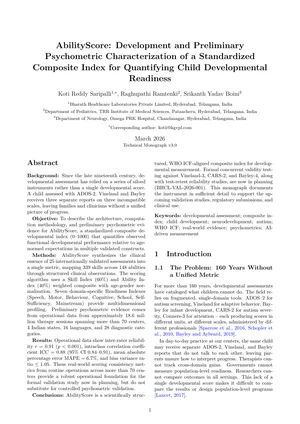
Development and preliminary psychometric characterization
What this supports: The public record describes the construction of AbilityScore and preliminary operational psychometric findings. The authors identify formal validation as planned.
Scope: Operational inter-rater reliability is not completed external concurrent validity. A repository deposit does not establish journal peer review or independent replication.
Research & outcomesOriginal reviewedStudy protocol
AbilityScore · External-validation protocol
Original protocol reviewed · Version 2.1 sets out planned validation methods
What this supports: The deposited protocol describes planned concurrent-validity, test–retest and minimal-clinically-important-difference research, including comparator instruments.
Scope: This record is a protocol preprint, not completed results. It does not establish that the planned recruitment, testing or external validation has been completed.
Study-by-study sources, populations and limitations
What this supports: The source publications describe twelve research topics across measurement, therapy, home practice, equity and participation. The study index identifies the populations and available original report links.
Scope: Small study cohorts cannot be replaced by cumulative network-service totals. Journal peer review, independent replication and ethics approval require their own documents. Findings apply to the populations and methods studied.
Company outcome claim recorded with its source and calculation boundary
What this supports: The company publications contain a headline improvement claim and a twelve-study narrative. These identify the claim that needs a transparent evidence trail.
Scope: The reviewed materials do not establish the full network-wide calculation or make it an individual outcome guarantee. Practitioner assurance over operational counts does not validate excluded outcome percentages.
Each letter retains its author, date and specific context
What this supports: The reviewed letters record appreciation and a recommendation for consideration of collaboration. The letter register identifies authors, dates and references.
Scope: Appreciation is distinct from a licence, procurement contract, signed MoU or clinical endorsement. A recommendation for consideration does not mean the proposed agreement was executed.
Nomination and achievement-docket records are not award decisions
What this supports: The source materials document preparation or submission for recognition and describe the cited nomination references.
Scope: A nomination, application or achievements dossier is not proof of an award being conferred. Publish an award title only with the issuer’s winner decision or award certificate.
PCT and Indian filings must be distinguished from granted patents
What this supports: The dossier and handout identify claimed patent-application references and the application-stage nature of the portfolio.
Scope: A PCT application is not a granted patent or worldwide enforceable protection. Each claimed application needs applicant, title, filing/publication data and current office status.
Registration, application and publication identifiers need separate ledgers
What this supports: An official copyright application list records a named Pinnacle artwork application. Company publications identify a wider intellectual-property and publishing portfolio.
Scope: An application listing is not a granted registration. Brand usage, ISBNs and book publication do not establish device efficacy or patent rights.
2025 Global Edition · Company-authored framework and study summaries
What this supports: The Whitebook explains the company’s framework and its historical study narrative. It is useful for tracing the origins of claims and the research portfolio.
Scope: It is not an independent issuer record. Historical scale figures, patent language, exclusivity claims and validation language need reconciliation with current originals.
25 July 2026 · Controlled institutional circulation
What this supports: The dossier consolidates references, regulatory chronology, research summaries and source exhibits. It explicitly supersedes the earlier edition.
Scope: A dossier is a map to evidence. Where it conflicts with an operative document or primary research record, the original source governs the verification entry.
7 September 2026 · Private & confidential investor handout
What this supports: The handout adds the September BIS licence, practitioner-report references, operational definitions and a consolidated registration and recognition narrative.
Scope: Its claims must be traced to their underlying instruments. Confidential circulation, research-stage language, operational counts and letter references require careful handling before public reuse.
Authorship and publication metadata read from the supplied books
What this supports: The supplied books establish the publication metadata printed in those editions and provide parent-facing context for the developmental journey.
Scope: A book’s publication is distinct from peer-reviewed clinical evidence or a professional qualification. The English and Telugu handbook copies show the same ISBN; separate-edition registration is not inferred.
Company-authored walkthrough · AbilityScore layers and programme cadence
What this supports: The reviewed company walkthrough explicitly distinguishes abilities, skills, domains and observations. It describes the personal development kernel, daily practice, monthly reassessment and participation goals.
Scope: A company-authored architecture and programme description is not independent clinical validation or a regulatory extension. Historical diagnosis, exclusivity, patent and endorsement wording is not adopted by this review. Current MD-5 and BIS originals control their respective scopes.
PinnacleAI® regulatory journey · Purpose, evidence and export readiness
Child-first purpose, licensed functions, research, Indian export documentation and source-linked international status
What this supports: This first-party narrative connects Pinnacle’s documented child-development purpose and seven-stage pathway with the named licensed device, Indian regulatory records, dated institutional measures and Free Sale Certificate. It provides one stable, source-linked page for families, clinicians, regulators, partners, editors, search engines and answer systems.
Scope: The narrative does not extend the scope of any licence, certificate, standard or study. It does not claim diagnostic authority, guaranteed outcomes, foreign approval, global exclusivity or comparative superiority. Each underlying fact is governed by its linked source record.
Explore six measures of Pinnacle’s reach, activity and resources, including institutional counts examined by an independent CA. Each keeps its counting unit, date and evidence type visible, so scale can be understood in the context of one child’s care.
Independent CA factual finding · SRS 4400
2.7 billion+
Structured developmental records
A large record system can preserve observations across a child’s developmental journey, supporting continuity and review.
2,700,000,000+ records in the SRS 4400 findings at 17 July 2026 (annexure p3, item 5). SAE 3000 separately covers a 2.5 billion+ floor.
What this figure counts
Session entries, assessment observations, technique ratings and other structured events. The evidence does not identify every record as an AI-training example or establish clinical effectiveness.
The useful family question is how the experience recorded across services informs a clear plan and review for your child.
31,052,382 in the SRS 4400 findings (annexure p3, item 1), at 17 July 2026. SAE 3000 provides limited assurance over the 31 million+ floor.
What this figure counts
The defined total includes assessments, screenings and parent training. It is not established as 31 million successful one-to-one therapy sessions; service volume and clinical success are separate measures.
A technique library is useful when a practitioner selects and adapts activities to a child’s goals, interests and everyday routines.
130,000 techniques: management-supplied update received 18 September 2026. The 7 September handout reports an earlier 90,000+ library.
What this figure counts
The updated repository count has not been reconciled to a dated inventory extract. The reviewed UDIN reports do not establish this figure, and technique count does not mean 130,000 separately validated interventions.
Behind each registration is a family seeking support. A family’s own goals and progress reviews remain the measure that matters to them.
792,614 unique beneficiary/family registrations in SRS 4400 (annexure p3, item 2), at 17 July 2026. SAE 3000 covers the 790,000+ floor.
What this figure counts
This is the defined registration measure. It is not a count of unique children with independently verified outcomes, and it does not itself measure family empowerment.
Families may connect with developmental support across borders, including through remote delivery where available.
Company-reported international reach in the July 2026 dossier, including remote delivery.
What this figure counts
Countries of family origin are different from countries with a physical Pinnacle centre. The reviewed practitioner reports do not establish this country count.
A network becomes relevant locally. Find your centre, its facility identifier and the source behind each listed document.
Network figure reported in the September handout. The practitioner-report criteria separately identify 49 operational centres at 17 July 2026.
What this figure counts
Network size, operational-centre counts and HFR identifiers are different measures. On 19 September 2026, 56 complete IDs matched in the NHPR dashboard and 33 displayed Approved; other workflow statuses and one masked Draft remain separate. An HFR record does not establish clinical outcomes or replace location-specific permissions.
INDEPENDENT EXTERNAL ASSURANCE · VERIFIED UDIN RECORDS
Independent reports. Verified references.
NPSY & Co., Chartered Accountants examined specified institutional claims and issued two signed reports. The reports record 31,052,382 services, 792,614 beneficiary/family registrations and 2.7 billion+ structured records under their stated definitions.
Signed 3 September 2026 · records as at 17 July 2026 · N Prasada Rao, Partner (membership 200027; firm 013580S).
UDIN identifies a practitioner’s report. HFR identifies a health facility. A company publication or management update supplies a stated figure. Each answers a different verification question.
Reports inspected; both UDINs matched in the live ICAI portal as Active on 19 September 2026. A UDIN does not expand a report’s scope or validate a clinical outcome. ICAI UDIN portal
Session entries, assessment observations, technique ratings and other platform events can preserve a record over time. The practical question is how that history helps the care team review your child’s plan.
Volume describes the size of the record system. Useful decisions also depend on data quality, consistent measurement, appropriate use and professional judgement.
This is not a count of unique children, independent clinical-trial observations or verified AI-training examples. A large count alone does not prove clinical effectiveness.
Observations become useful when people can review them together.Why do some Pinnacle sources say 2.5 billion+ and others 2.7 billion+?
The July dossier used a 2.5 billion+ floor and retired earlier 2.7 billion wording. The September handout subsequently reports 2.7 billion+ observed row counts. The source review distinguishes the 2.5 billion floor assertion in limited assurance from the 2.7 billion factual row-count finding under agreed procedures. Those procedures do not provide an assurance opinion.
These are dated measures with different reporting roles. Neither should be described as an audited count of AI-training examples. Restricted practitioner reports are not republished here.
Search the supplied facility and district records. Match the exact premises before relying on a document; a network credential does not cover every centre automatically.
56HFR identifiers included and source-reviewed
33Approved statuses confirmed in the reviewed account
All 53 identifiers from the supplied workbook and certificate collection are included, alongside three additional dashboard IDs. Each of the 56 complete IDs was matched in the NHPR account reviewed on 19 September 2026. Identifiers are not a count of distinct operating centres.
Approval verified The tick confirms that this exact ID displayed Approved in the NHPR account reviewed on .
Every supplied ID remains visible. Unticked IDs have their exact dated account observations under Source details. Pinnacle confirms its registration coverage is complete and advises that records may span multiple accounts. The dated portal check in this review covers one account; ticks identify the approval statuses confirmed in that check.
56 HFR IDs recorded · 33 approval statuses verified · 8 district summaries
HFR identifierApproval verified
Ananthapuram
HFR identifier
IN2810053167
Source date / review
14 Apr 2026
Source
All Centers With HFR.xlsx · row 49
2nd Cross Rd, opp. to SIU church, beside BABY Hospital, Ashoknagar, Sai Nagar, Anantapur, Andhra Pradesh Source postcode: 515001
Approved status confirmed for this HFR ID in the NHPR account reviewed on 19 September 2026.
Dated account details
NHPR workflow: Approved Reviewed account · 19 September 2026. Other accounts have not been reconciled in this review.
No - 11-14-321/3, Building Name - K Square, 3rd Floor New Siri Nagar Colony Beside Croma store, above Raymond Store, near L.B Nagar Circle, Hyderabad, Telangana 500074 Source postcode: 500074
HFR identifier included and source-reviewed. Open the record for its dated account observation and documentary sources.
Dated account details
NHPR workflow: Submitted Reviewed account · 19 September 2026. Other accounts have not been reconciled in this review.
The 56 complete HFR IDs include all 53 earlier source-inventory IDs and three additional dashboard IDs. 33 displayed Approved on 19 September 2026; the other workflow statuses and one masked Draft are distinguished in the full register. Eight district summaries describe 29 certificate copies; four district originals were individually inspected. Similar names are not treated as an address match. Full HFR register · Full district register
Read a parent handbook, follow a paper to its original publication, or explore the wider guidance. Each source helps you ask a more informed question about your child’s support.
Seven DOI-linked works, parent books in English and Telugu, the twelve-study company portfolio, and verified researcher profiles — connected in one reading library.
Four distinct standards help explain the architecture: health information, functioning and participation, interventions, and clinical terminology. Their value depends on how accurately they are implemented.
World Health Organization
ICD-11 · health information
A common classification and clinical terminology for recording, comparing and aggregating health information. It gives health-related records a consistent reference language.
Pinnacle’s dossier describes ICD-11 reference alignment; this does not make the software diagnostic.
A framework covering body functions and structures, activities, participation and environmental context. It helps keep daily life and the support needed to participate in view.
Pinnacle’s handout and dossier describe ICF mappings. The dossier’s b-code examples describe body functions; activity, participation and environment need their own relevant codes.
A classification for recording and analysing health interventions through their target, action and means. It can help describe what intervention is delivered in a consistent way.
Pinnacle’s dossier describes ICHI intervention coding within its architecture.
A detailed clinical terminology that represents information through concepts, descriptions and relationships. It supports consistent meaning in electronic clinical records.
Pinnacle’s dossier describes SNOMED CT terminology alignment. SNOMED International is the responsible organisation.
Pinnacle’s framework, connected to international languages
The Evidence Dossier describes mappings to ICD-11, ICF and ICHI, alongside SNOMED CT and LOINC terminology and HL7 FHIR representations. These are company-described architecture and mapping claims. Correctly implemented mappings can support more consistent records, exchange and analysis across settings.
The reviewed evidence does not include a complete item-by-item mapping audit or implementation-conformance report. Classification alignment does not establish WHO, UN or SNOMED endorsement, validate the developmental score, or expand the MD-5 intended use.
A population-scale ambition. One child’s life at the centre.
Pinnacle describes a connected developmental-support architecture designed for wider deployment: a common framework, a persistent child-specific record, guided daily practice and human review. Its potential value at scale is continuity—helping families and professionals work from the same developmental direction across home, therapy and school.
What makes “sovereign-ready” and “world-ready” meaningful?
For a health system, sovereign readiness means demonstrable control over data and operations under its own governance requirements. International readiness also needs validated mappings, appropriate local language and workflows, applicable regulatory permissions, and evidence of safe, useful performance in that setting.
Validate the mappings and test information exchange with the systems that will actually use it.
Capacity and real-world value
Test deployment performance, accessibility and child-centred outcomes in the intended population and setting.
The reviewed MD-5 and BIS scope establish specific regulatory and quality-system foundations. Reported network activity and information-security records add context. Together they support examining the deployment proposition; they are not a sovereign-grade certification or authorisation to operate in every country.
How to interpret reported data volume
The reported 2.7 billion+ structured records count database rows and events. They do not establish a nationally representative population, verified AI-training volume or population-level clinical effectiveness.
Pinnacle’s stated mission has practical connections to the UN Sustainable Development Goals: access to support, early learning, inclusion and accountable collaboration.
SDG 3
Health and well-being
A mission to make developmental support clearer and more accessible to families.
These are mission connections, not measured SDG achievements, an official UN partnership or UN endorsement. Each child’s right to inclusion remains independent of a readiness score.
Independent guidance explains the importance of monitoring, caregiver participation, coordinated support and inclusion. These organisations do not endorse or evaluate Pinnacle through the references below.
Development happens across a child’s whole day.
The Nurturing Care Framework brings together health, learning, responsive caregiving and supportive environments.
Pinnacle’s licensed non-diagnostic software includes ability measurement and readiness tracking. This CDC reference does not validate AbilityScore as a screening test.
NICE recommends coordinated multidisciplinary support and developmentally appropriate parent, carer or teacher involvement for autistic children and young people.
Pinnacle describes integrated therapies and regular plan review. Families can ask how professionals share goals and who coordinates their child’s support.
Pinnacle’s pathway works toward communication, daily living and participation. Readiness goals do not determine a child’s right to education or inclusion.
Different organisations address diagnosis, assessment, digital treatment, integrated services or provider software. A useful comparison starts with the job each is designed to do.
Pinnacle’s documented combination
Non-diagnostic developmental-support software with an issued MD-5, a BIS schedule naming connected developmental modules, and a company-described seven-stage care pathway. For families, the important connection is between measurement, a plan, everyday practice and review.
Prescription software for attention function measured by computer testing in children aged 8–17 with specified ADHD presentations, within a therapeutic programme.
Its published model combines diagnostics, medical care, ABA, developmental therapies and mental-health counselling, involving family, home, school and community.
Integrated child-development care exists internationally. Compare actual coordination, local availability and evidence for the services your child needs.
This is a targeted review of five examples, not an exhaustive worldwide census or a head-to-head effectiveness study. It establishes no overall winner, cross-country regulatory equivalence, largest-dataset ranking or global exclusivity.
The better comparison question
“Which combination of measurement, professional support, home practice, progress review and participation goals is actually available for my child—and can I inspect the evidence?”
NPSY & Co., Chartered Accountants, issued an SAE 3000 limited-assurance report and a separate SRS 4400 report of factual findings on 3 September 2026. Both UDINs were verified Active on 19 September 2026: 26200027GMBLXU4868 and 26200027HCNFEI9138. The original ICAI verification receipt and a claim-to-page map are linked here. These are independent practitioner evidence for the specified institutional assertions; clinical study results have their own research records.
The supplied MD-5 lists PinnacleAI® GPT-OS v1.0.0 as a Class B, non-diagnostic developmental-support device. Its scope is tied to the named device, version, intended use and premises; it does not establish diagnostic authority or guarantee clinical outcomes.
Are an MD-3 application and an MD-5 licence the same?
No. MD-3 is an application for a manufacturing licence. MD-5 is the issued manufacturing licence. The original application is reviewed; Class B is recorded on the issued MD-5. The separate issued classification decision copy was not available for inspection.
They describe specified management systems and the activities and locations within their scope. They do not establish the effectiveness of every intervention or promise a particular outcome for a child.
Does a research protocol prove external validation?
No. A protocol describes planned methods. The AbilityScore external-validation record here is a protocol; completed results and their limitations are needed before treating that study as completed validation.
No. Match the named institution and premises on each document. All 56 complete HFR identifiers were matched in the authenticated NHPR dashboard on 19 September 2026; 33 displayed Approved. Other workflow statuses and one masked Draft are shown separately. Eight district summaries remain separate. An identifier match is not a finding that every centre is approved or currently operating.
Who can help with a correction or a current document?
Contact Sourabh Sashank, Lead PinnacleAI® and evidence owner, at care@pinnacleblooms.org or 9100 181 181. Include the record title, reference number and source date so the relevant document can be located.
What does Pinnacle’s 2.7 billion+ data-point figure mean?
The September 2026 company handout reports 2.7 billion+ structured platform records, based on database rows/events with a 17 July 2026 cutoff. Examples include session entries, assessment observations and technique ratings. The number is not a count of unique children, independent trial observations or verified AI-training examples.
Does this establish the world’s largest child-development dataset?
No comparable worldwide ranking is established. For example, CentralReach reports over 5 billion clinical and financial data points, using a different counting basis. A valid comparison would need common definitions, dates, populations, data quality and permitted uses.
Does the MD-5 licence approve the entire child-development lifecycle?
The MD-5 names PinnacleAI® GPT-OS v1.0.0 and defined non-diagnostic functions for ages 0–12. The broader BIS schedule lists software processes and developmental-support modules across the journey. These instruments establish different scopes; neither guarantees outcomes or certifies global exclusivity.
Do WHO, UNICEF, CDC, NICE or UNESCO endorse Pinnacle?
No endorsement is established by the references on this page. Their guidance explains why monitoring, coordinated support, caregiver participation and inclusion matter. Pinnacle’s own documents must separately establish what Pinnacle provides.
What is the purpose of the Pinnacle developmental pathway?
Pinnacle’s purpose is to help children grow toward self-sufficiency and participation in mainstream life, with the support and accommodations each child needs. Its tagline is “Every child deserves a wonderful life.” The described approach connects ability measurement, child-specific planning, coordinated intervention, everyday practice, tracking, correction and reassessment. Individual outcomes vary.
What do 17 domains, 79 abilities and 349 skills mean?
Pinnacle describes these as different layers of its developmental framework: 17 domains, 79 abilities and 349 skills, with 591 observations and AbilityScore on a 0–1000 scale. The totals belong to Pinnacle’s architecture, not a WHO-defined numerical hierarchy. Individual plans select relevant priorities. The earlier Whitebook used 344 skills across six domains; validation of an earlier version should not be automatically transferred to the newer framework.
The company sources describe 7–9 daily techniques selected for the child’s programme, human feedback through the Fusion tracking and correction module, and monthly AbilityScore refresh. The care team should explain the child-specific goals, practice guidance, review schedule and any adjustments. This is a programme description, not a guaranteed outcome.
How do ICD-11, ICF, ICHI and SNOMED CT relate to PinnacleAI®?
Pinnacle’s dossier describes architecture and mappings using WHO’s ICD-11, ICF and ICHI, alongside SNOMED CT terminology from SNOMED International. Their roles are health information, functioning and participation, interventions, and consistent clinical meaning. Correct implementation can support interoperability; an item-by-item mapping audit was not supplied. Alignment is separate from endorsement, clinical validation and the licensed device’s intended use.
Does Pinnacle focus on a diagnosis or on everyday-life goals?
Families may arrive with questions about autism, ADHD, communication, sensory processing, movement, learning or other developmental concerns. Pinnacle’s stated purpose centres on the capabilities that help each child grow toward self-sufficiency and participate in mainstream life, with the support and accommodations they need. These are examples of individual goals, not promised results. Professional assessment identifies the support appropriate to each child; diagnosis and medical care remain important where indicated. The licensed software’s scope is non-diagnostic developmental support for ages 0–12, not treatment of every condition.
Is PinnacleAI® certified as sovereign-grade or authorised worldwide?
The reviewed documents do not establish a sovereign-grade certification or worldwide market authorisation. Pinnacle describes an architecture intended for population-scale developmental support. A specific deployment needs documented local control and governance, validated interoperability, applicable permissions, operational capacity and evidence of performance for that population. MD-5 and BIS provide the particular scopes shown in their records.
Are parents and caregivers named in the MD-5 intended use?
Yes. The MD-5 annexure states that PinnacleAI® GPT-OS is intended to assist parents, therapists, educators and caregivers through developmental ability measurement, readiness tracking, progress forecasting and adaptive therapy-plan support for ages 0–12. This explicitly includes family users of the licensed software. It does not confer professional therapist credentials or register homes as therapy centres; worldwide exclusivity has not been established.
A practical reading guide to the credentials, report types and international classifications used on this page. Each definition links to its Pinnacle source record.
SaMDSoftware as a Medical Device
Software intended for a medical purpose without being part of a hardware medical device. PinnacleAI® GPT-OS is listed as Class B, non-diagnostic developmental-support software in the supplied MD-5.
The application submitted for a licence to manufacture Class A or Class B medical devices. An application is a step in the regulatory record; it is not the issued licence.
The issued licence records the named manufacturer, premises, device and intended use. Pinnacle’s supplied MD-5 names PinnacleAI® GPT-OS v1.0.0 for non-diagnostic developmental support, ages 0–12.
BIS scopeBureau of Indian Standards licence and scope schedule
The reviewed BIS record describes the management system and activities within its named scope, including developmental-support software modules. It does not establish every centre’s registration or guarantee clinical outcomes.
The Health Facility Registry assigns facility identifiers. On 19 September 2026, 56 complete IDs were matched in the authenticated NHPR dashboard; 33 displayed Approved. Other workflow statuses and one masked Draft are shown separately. A directory match is not a finding about current operations, clinical quality or outcomes.
An identifier for a practitioner’s document. Both supplied UDINs were matched in the live ICAI portal on 19 September 2026 and showed Active. A UDIN authenticates registered particulars; it does not extend the report’s scope.
SAE 3000Limited-assurance report in this evidence collection
The supplied practitioner report gives limited assurance over specified institutional assertions and counting criteria. Read its dated thresholds and scope; it does not validate every headline statistic or a child’s clinical outcome.
SRS 4400Agreed-upon procedures and factual findings
The supplied report records procedures and findings for defined institutional counts. It does not provide an assurance opinion. Its observed counts and the SAE 3000 assertion floors have different reporting roles.
ICD-11International Classification of Diseases, 11th Revision
World Health Organization. A common classification and clinical terminology for recording, comparing and aggregating health information. It gives health-related records a consistent reference language. Pinnacle’s dossier describes ICD-11 reference alignment; this does not make the software diagnostic.
ICFInternational Classification of Functioning, Disability and Health
World Health Organization. A framework covering body functions and structures, activities, participation and environmental context. It helps keep daily life and the support needed to participate in view. Pinnacle’s handout and dossier describe ICF mappings. The dossier’s b-code examples describe body functions; activity, participation and environment need their own relevant codes.
ICHIInternational Classification of Health Interventions
World Health Organization. A classification for recording and analysing health interventions through their target, action and means. It can help describe what intervention is delivered in a consistent way. Pinnacle’s dossier describes ICHI intervention coding within its architecture.
SNOMED International. A detailed clinical terminology that represents information through concepts, descriptions and relationships. It supports consistent meaning in electronic clinical records. Pinnacle’s dossier describes SNOMED CT terminology alignment. SNOMED International is the responsible organisation.
Each conclusion reflects the documents inspected. Historical certificates, study protocols and company-reported claims are identified precisely, so you can see what each source establishes.
Document review18 September 2026
Initial source review: 15 September. Selected originals and the flagged evidence conclusions rechecked on 18 September.
Licence and registration copies: read their stated scope
Original licence and registration copies are reviewed by named entity, activity, reference and printed dates.
Evidence scope: Current suspension, cancellation, renewal or amendment status requires a dated issuer check. Only exact live registry matches receive the registry badge.
Outcome claims: keep the calculation boundary visible
The headline improvement claim is recorded as company-reported. No verified network-wide percentage is concluded from this document set.
Evidence scope: The SAE 3000 scope excludes outcome-study figures. A defined denominator and reproducible calculation are required to evaluate the headline claim.
Centre evidence: match each document to its premises
All 53 earlier source IDs matched in the authenticated NHPR dashboard on 19 September 2026. Three additional complete IDs bring the register to 56: 33 Approved, 14 Query Raised, 4 Submitted, 4 Rejected and 1 Query Resolved. One masked Draft is separate. Workbook and certificate references remain visible.
Evidence scope: These are dated dashboard workflow statuses, not findings about present operations or clinical quality. Additional IDs do not establish replacement or cancellation. Workbook RS flags remain separate. Nellore’s inspected district certificate period ended on 30 October 2024; an HFR match does not renew a district certificate.
Both exact UDINs showed Active in the ICAI portal on 19 September 2026, with practitioner and signing particulars matched. Restricted full reports are not republished here.
Evidence scope: The reports’ circulation restrictions remain attached. A UDIN match authenticates particulars and does not enlarge a report’s assurance scope.
19 September 2026 · HFR dashboard check: matched all 53 earlier source IDs, added three dashboard IDs and recorded each workflow status. The register has 56 complete IDs; 33 displayed Approved and one masked Draft is separate.
19 September 2026 · Research and reading: linked DOI publications, original parent books and matched author profiles; added expandable topic navigation and reduced duplicate downloads.
18 September 2026 · Purpose, pathway and imagery: added the documented AbilityScore layers, daily practice and monthly review cycle, original-source regulatory scope, classification and SDG context, plus three clearly labelled Pinnacle World illustrations. Improved phone and tablet layouts.
18 September 2026 · Section descriptions and identity: connected the brand and legal entity, added section links and a terminology guide, and matched structured page descriptions to the visible evidence.
18 September 2026 · Complete HFR inventory and statistics: added all 52 supplied workbook centres, reconciled 53 distinct HFR IDs across source sets, and linked six headline statistics to definitions and source records.
18 September 2026 · Family meaning and global context: added family relevance to all 33 records, dated data-scale definitions, the distinct MD-3/MD-5/BIS scopes, international guidance and five sourced global comparisons. Enabled public indexing and expanded matching structured data.
18 September 2026 · Review conclusions: rechecked the flagged source material; separated original review from historical validity, application status, study protocols and company-reported outcomes. Improved typography, navigation and source icons.
15 September 2026 · Experience update: added family explanations, centre lookup, evidence filters, record links, correction requests and the source-review register; corrected mobile layout.
15 September 2026 · Initial source review: recorded the operative MD-5 reference 000248, September BIS licence, legal identity registry match and source-specific research limitations.
Use “Ask about this record” beside any entry. Include the reference, source date and the correction needed. The link prepares an email for you to review and send.
Evidence owner: Sourabh Sashank · Lead PinnacleAI® · care@pinnacleblooms.org · 9100 181 181. The dossier names its own approving authority; that approval is not presented as approval of this page.
A record is useful when you can see both what it supports and the limits of that support.
01 / PROVENANCE
Start with the source
Original documents take priority over cover letters, brochures and website summaries. The review date describes our inspection, not a fresh confirmation from the issuer.
Business identity, quality systems, clinical evidence and government appreciation serve different purposes. Ask what each one means for your child’s plan; individual outcomes vary.
A supplied original or primary publication record was inspected. Current status and independent validation are separate checks.
Registry record matched
The exact entity and identifier were checked against an official registry on the review date.
Company-published
Published by Pinnacle or its authors. This label does not imply independent validation.
Evidence scope
An adjacent scope label distinguishes a historical certificate, an application, a study protocol or a company-reported outcome. Original review does not expand what the document establishes.
Maintains the verification evidence register, coordinates source updates and responds to evidence questions and corrections.
Pinnacle Clinical Committee
The designated committee brings together paediatric speech therapists, occupational therapists, ABA therapists, special education therapists, data scientists, technology experts and statisticians. Additional qualified specialists may contribute where needed.
Review parent-facing explanations against the cited source, the intended use of the named software version and the child's individual care context. Include additional qualified specialists when the subject requires them.
Current review status: Clinical review completed by the Pinnacle Clinical Committee; confirmation recorded on 19 September 2026.
The confirmation applies to the parent-facing clinical explanations in the 19 September 2026 published edition. Later substantive clinical changes require a new review record. Automatic translations remain labelled as machine-assisted.
Coverage confirmation: Pinnacle confirms its organisational coverage is complete. Confirmation recorded: 19 September 2026. Individual records retain their source dates and the exact scope of the documents inspected.
Added a guided workflow, an eight-report explorer and focused reading paths. Linked seven DOI publications, parent books and author profiles. Clarified that the report presentation version is separate from the SaMD software version.
18 September 2026
Updated selected source conclusions, regulatory scope, scale definitions and the documented developmental pathway.
15 September 2026
Prepared the initial evidence register and centre-document inventory.
For a current original or a correction, contact Sourabh Sashank, Lead PinnacleAI®, at care@pinnacleblooms.org. Each evidence record retains its own source-review date.
The source register was prepared on 15 September 2026, with selected originals and review conclusions rechecked on 18 September 2026. The page does not represent a regulator’s certification service. The evidence owner can help with source questions and corrections. The cited organisations have not endorsed this page. Live registry matches are counted only when an exact record has been checked against an official registry source.
Public document copies preserve issuer, entity, reference, scope and dates while removing personal identifiers and signatures where appropriate. A document’s stated validity is recorded separately from a live check for suspension, cancellation or changes. View file-integrity records.
Research protocols describe planned methods. Company summaries and operational totals are not substitutes for completed study results with methods, populations, outcomes and limitations.
Free Sale Certificate FSC/MD/2026/000741 adds export documentation to the Indian medical-device foundation for the licensed PinnacleAI GPT-OS v1.0.0. It supports country-specific registration and market-access work under each importing country’s requirements.
Tell us what matters most in your child’s everyday life. Ask how Pinnacle would understand their abilities, build a plan with you and review progress. Start with a conversation.