
PARENT GUIDES · PINNACLEAI®
What does my child’s AbilityScore® mean?
AbilityScore® is Pinnacle’s structured description of a child’s present developmental abilities. Read it alongside the assessed skills, everyday observations and the care team’s explanation. The useful question is: what can my child do now, and what should we work on next?
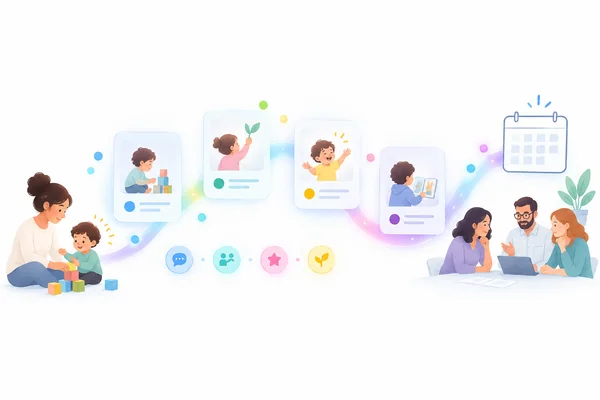
The connected developmental journey
- Understand abilities
- Plan for this child
- Coordinate support
- Practise at home
- Track and adjust
- Reassess
- Grow and participate
Start with abilities, then look at the number
Section linkPinnacle’s current company descriptions organise development into 17 domains, 79 abilities and 349 skills. These are different levels of the framework, rather than interchangeable counts. AbilityScore® presents a structured starting point for discussing the child’s strengths and next priorities.
The reviewed dossier describes clinical AbilityScore® as clinician-administered and clinically governed. A parent’s observations contribute valuable context; a questionnaire and a clinical assessment should be explained as different parts of the process.
Read the overall profile and the focused reports
Section linkThe supplied September examples contain an overall AbilityScore® / TherapeuticAI® report and seven focused readiness reports: speech, behaviour, motor, study/IQ, school, self-sufficiency and mainstream readiness. Each view gives the family and care team a way to discuss a different part of daily life.
The Study/IQ Readiness report title does not establish it as an independent IQ test. A readiness label is not a diagnosis or a promise of admission to school.
Ask what sits behind the score
Section linkLook for who assessed the child, when the assessment happened and the situations the observations describe. Ask the care team to show the skills that inform the profile and connect them to what the child does at home, in learning and with other people.
For example, a family might ask: ‘Which communication ability are we working on, and what change would we notice during our usual day?’ This is a discussion prompt, not an interpretation of any child’s score.
Compare your child’s progress over time
Section linkThe supplied September report examples display the overall score and readiness indices on a 0–1000 scale. Older methodology material describes readiness indices on a 0–100 scale. Confirm the report version and scale before comparing results; do not treat different versions as directly equivalent.
Pinnacle’s workflow describes monthly reassessment. Ask what has changed in everyday life, which goals remain useful and how the next plan follows from the review. The report’s presentation version is separate from the medical-device software version.
Understand the stage of the research
Section linkThe methodology preprint describes development and preliminary measurement findings. The separately published external-validation protocol sets out planned research; it is not a completed validation result. The evidence library links both records so families and professionals can read what each one establishes.
A score helps organise a conversation. It does not define a child’s worth, guarantee independence or determine their right to belong and participate.
Questions to take to your care team
Section link- Which abilities and daily-life priorities does this profile highlight?
- Who completed the assessment, using which report version and scale?
- What will we practise, and what change will we look for at the next review?
Quick answers
Section linkIs AbilityScore® a diagnosis?
PinnacleAI® is described in the reviewed MD-5 as non-diagnostic developmental-support software. AbilityScore® should be discussed as a developmental ability profile, not used as a disease diagnosis.
Can I compare two different report versions?
Ask the care team to confirm the scale and instrument version first. The reviewed September reports and older methodology material describe different readiness-index scales; a direct comparison is not established by those sources.
Sources and exact context
Section link- Pinnacle company walkthroughPage 26: framework; pages 35, 37: feedback and monthly review
- Pinnacle Evidence DossierPage 40: assessment governance; pages 48–49, 52–54: planning, oversight and access
- AbilityScore® methodology preprintMethods and preliminary evidence; programme description, page 3
- AbilityScore® external-validation protocolBHCL-VAL-2026-001, version 2.1; planned research
- Report-format review and eight-report guideSupplied September examples; presentation version V-1.6.9.9, separate from SaMD version
- BIS: MD/L-2026029599Schedule, physical PDF page 2; named quality-system activities and modules
- MD-5: MFG/MD/2026/000248Intended-use annexure; original source copy linked on the record
. Source-based editorial explanation, prepared with AI assistance. No clinical review is claimed.
PinnacleAI® GPT-OS: non-diagnostic developmental support, ages 0–12. Plans and outcomes are individual.