
Methodology and preliminary psychometrics — preprint
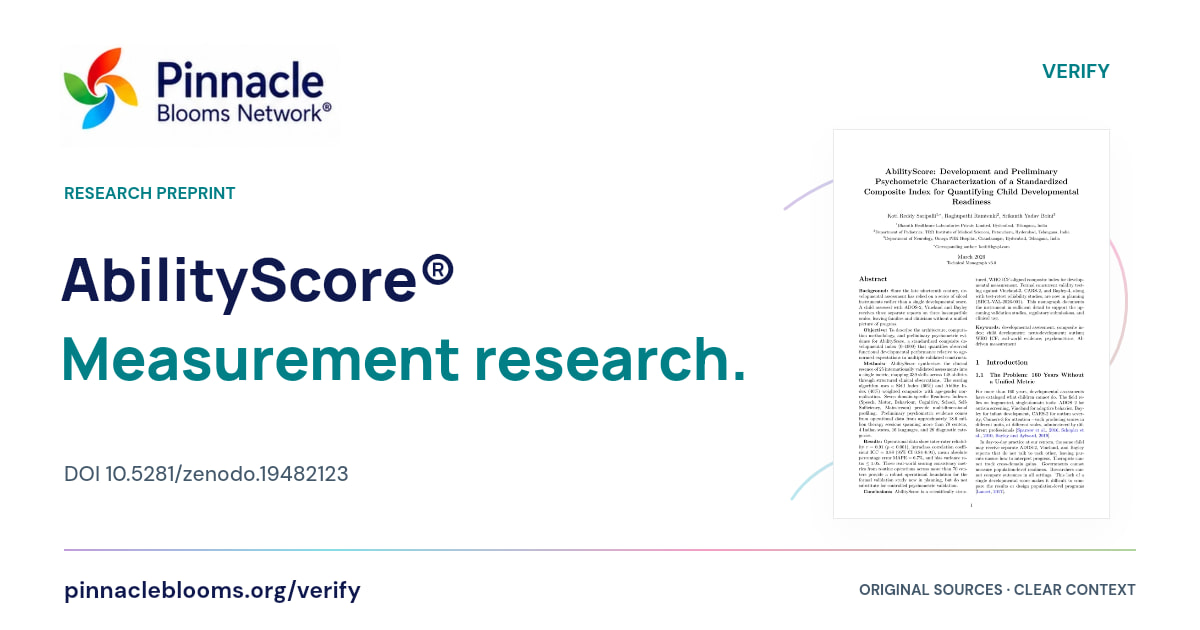
AbilityScore: Development and Preliminary Psychometric Characterization of a Standardized Composite Index for Quantifying Child Developmental Readiness
Saripalli, Koti Reddy · Ramtenki, Raghupathi · Boini, Srikanth Yadav
Operational preliminary evidence; formal validation described as planned.
The manuscript title page identifies Technical Monograph v3.0. The repository metadata does not specify a version; this page cites the manuscript version. This manuscript describes 339 skills and 148 abilities; the current company-described framework uses 349 skills and 79 abilities. The original abstract is preserved as version-specific evidence.
Author-written abstract
Section linkBackground: Since the late nineteenth century, developmental assessment has relied on a series of siloed instruments rather than a single developmental score. A child assessed with ADOS-2, Vineland and Bayley receives three separate reports on three incompatible scales, leaving families and clinicians without a unified picture of progress.
Objective: To describe the architecture, computation methodology, and preliminary psychometric evidence for AbilityScore, a standardized composite developmental index (0–1000) that quantifies observed functional developmental performance relative to age-normed expectations in multiple validated constructs.
Methods: AbilityScore synthesizes the clinical essence of 25 internationally validated assessments into a single metric, mapping 339 skills across 148 abilities through structured clinical observations. The scoring algorithm uses a Skill Index (60%) and Ability Index (40%) weighted composite with age-gender normalization. Seven domain-specific Readiness Indexes (Speech, Motor, Behaviour, Cognitive, School, Self-Sufficiency, Mainstream) provide multidimensional profiling. Preliminary psychometric evidence comes from operational data from approximately 18.6 million therapy sessions spanning more than 70 centers, 4 Indian states, 16 languages, and 28 diagnostic categories.
Results: Operational data show inter-rater reliability r = 0.91 (p < 0.001), intraclass correlation coefficient ICC = 0.88 (95% CI 0.84–0.91), mean absolute percentage error MAPE = 6.7%, and bias variance ratio ≤ 1.05. These real-world scoring consistency metrics from routine operations across more than 70 centers provide a robust operational foundation for the formal validation study now in planning, but do not substitute for controlled psychometric validation.
Conclusions: AbilityScore is a scientifically structured, WHO ICF-aligned composite index for developmental measurement. Formal concurrent validity testing against Vineland-3, CARS-2, and Bayley-4, along with test-retest reliability studies, are now in planning (BHCL-VAL-2026-001). This monograph documents the instrument in sufficient detail to support the upcoming validation studies, regulatory submissions, and clinical use.
Text reproduced from the original manuscript, PDF page 1. Read the source. Reproduced under CC BY 4.0; original authors credited above. Paragraph formatting only; wording retained.
Read the original
Section linkBibliographic source checked 2026-09-19. Publication status and author statements are retained as attributed source content.
Cite this publication
Use the original publication’s authors, date, version and DOI. The publication status remains part of the citation.
Author profiles and related publications
Pinnacle Blooms Network is a brand of Bharath Healthcare Laboratories Private Limited. View legal identity evidence.